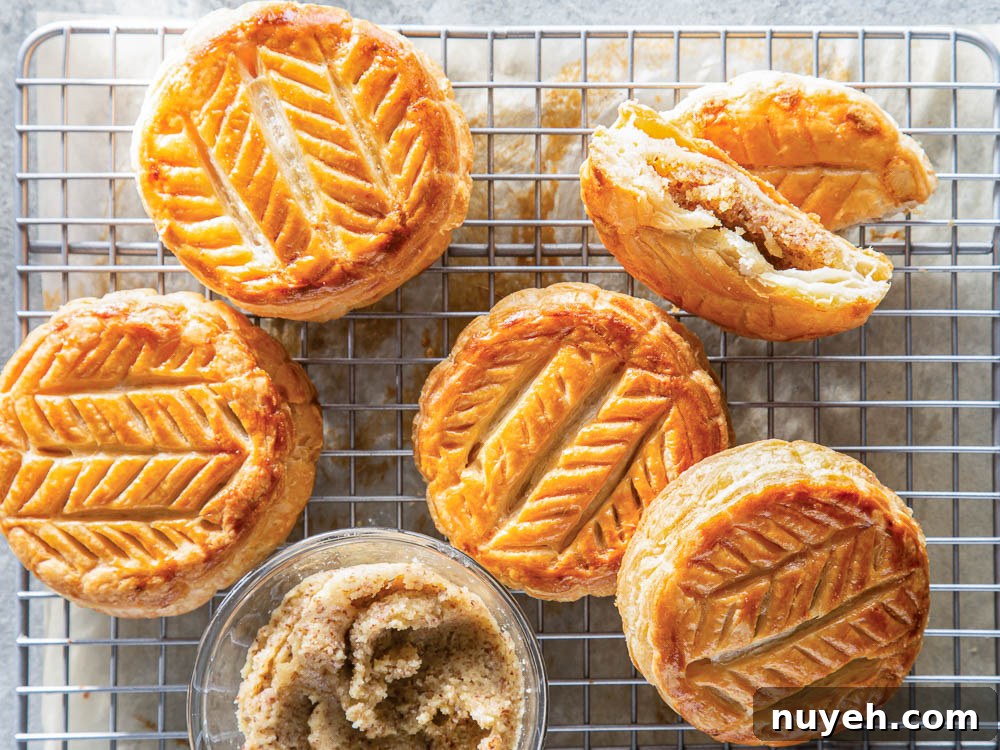
The galette des rois, or French king cake, is a classic pastry traditionally enjoyed on Epiphany (January 6) to commemorate the arrival of the three kings to the infant Jesus. This version uses an easy rough puff pastry and a simple almond frangipane to create individual, elegant galettes. With minimal equipment and a few chilling periods, you’ll get crisp, buttery layers and a beautiful decorative top. Below you’ll find a straightforward recipe, practical tips for success, and a short guide to scoring a herringbone pattern for a professional finish.
Mini Galettes des Rois
Ingredients
- 1¼ cups (284 grams) unsalted butter, cubed
- 2¼ cups (281 grams) plus 1½ teaspoons (4.5 grams) all-purpose flour, divided
- 2⅛ teaspoons (6 grams) kosher salt, divided
- ½ cup (120 grams) ice water
- 3 tablespoons (42 grams) unsalted butter, room temperature
- ½ cup (48 grams) superfine natural almond flour
- ¼ cup (50 grams) granulated sugar
- 2 large egg yolks (38 grams), divided
- ¼ teaspoon (1 gram) almond extract
- 1 whole almond (optional)
- 1 teaspoon (5 grams) water, room temperature, plus more for brushing
Instructions
- Place the cubed butter in the freezer for about 30 minutes to firm it up. Firm, cold butter is key to getting distinct layers in the rough puff pastry.
- In a food processor, combine 2¼ cups (281 g) of the all-purpose flour and 2 teaspoons (6 g) of the salt. Pulse briefly to mix. Add the frozen, cubed butter and pulse until the largest pieces are about the size of a dime.
- With the processor running, stream in the ½ cup (120 g) ice water slowly, stopping as soon as the dough just comes together into a loose ball. Avoid overprocessing. Turn the dough out onto a lightly floured surface and shape it into a 6-inch square. Wrap in plastic wrap and refrigerate at least 30 minutes to relax the gluten and keep the butter cold.
- On a lightly floured surface, roll the chilled dough into a 15×7-inch rectangle. Lightly flour as needed to prevent sticking. Fold the rectangle into thirds like a letter, rotate the dough 90 degrees, and repeat the rolling-and-folding process two more times. This creates the laminated layers that make the pastry flaky. Wrap and refrigerate at least 20 minutes before cutting.
- Preheat two baking sheets lined with parchment paper. Divide the dough in half. Working with one half at a time on a lightly floured surface, roll each portion to a 12×9-inch rectangle (about 1/8 inch thick). Using a 4-inch round cutter, cut five circles from each half, placing them about 2 inches apart on the prepared pans.
- Make the frangipane: In a small bowl, beat the room-temperature butter until smooth. Add the almond flour, granulated sugar, 1 egg yolk (19 g), almond extract, the remaining 1½ teaspoons (4.5 g) of flour, and the remaining ⅛ teaspoon salt. Stir until fully combined and smooth.
- Using a fork, gently dock the centers of the 5 bottom dough circles to prevent large air pockets while baking. Spoon about 2 tablespoons (≈30 g) of frangipane onto each docked circle, leaving a ½ to ¾ inch border around the edge. If you’re including a fève, place a whole almond (or other small token) in the frangipane of one galette.
- Brush the exposed dough edge with room temperature water, then top each filled circle with a second dough circle. Press the edges together to seal, using your fingertips to flatten the seam, and make a shallow decorative notch around the edge (see pattern section below). Refrigerate the assembled galettes for 30 minutes to firm up before baking.
- Preheat the oven to 400°F (200°C). Prepare an egg wash by whisking together 1 egg yolk (19 g) and 1 teaspoon (5 g) room temperature water. Lightly score the tops with a small knife to create your design—take care not to cut all the way through. Brush the tops with egg wash, avoiding the edges so they remain sealed. Cut 5–6 small, discreet slits in the scored design to allow steam to escape.
- Bake at 400°F (200°C) for 15 minutes. Then rotate the pans, reduce the oven temperature to 375°F (190°C), and continue baking until the galettes are deep golden brown, about 10–15 minutes more. If needed, reopen slits in the tops during baking to release steam. Serve warm or cool completely on a wire rack.
Notes and Tips
Pro Tip: In France it’s traditional to hide a fève (originally a bean, now often a small figurine) inside the galette; whoever finds it in their slice is “king” or “queen” for the day. For an edible alternative, an almond works well and is easy to find. You can also substitute a small piece of dried fruit or a tiny trinket—just be sure to warn guests if the fève is inedible.
Keep the pastry and butter cold throughout the process for the flakiest layers. If the dough becomes too soft at any point, chill it for 15–30 minutes before continuing. Store leftovers covered in the refrigerator for up to two days and refresh in a warm oven for a few minutes to restore crispness.
Pattern Perfection
A simple guide to scoring an elegant herringbone pattern
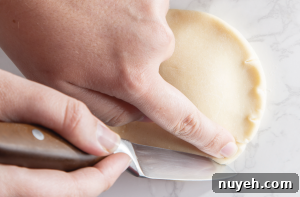
- To create a classic scalloped edge, press the dough edge down with your fingertip. Immediately beside your fingertip, use the back of a small knife to make a shallow notch. Move your fingertip to the other side of the notch and repeat all the way around the galette for a neat scalloped border.

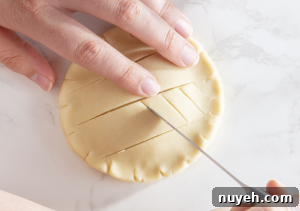
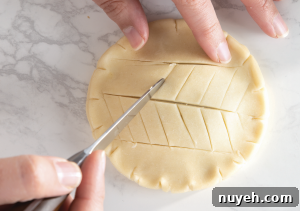
Using a small, sharp knife, lightly score three evenly spaced parallel lines across the top to create four columns. Do not cut through the pastry. In one column, score evenly spaced diagonal lines down the length to form the first set of herringbone strokes.
In the adjacent column, mirror the diagonal lines to create a subtle “V” or chevron where the two sets meet. Repeat for the outer columns, stopping about ¼ inch from the dough edges. Finish by brushing with egg wash (avoid the sides), and cut several small slits in the design to vent steam while baking.